
Which U.S. coins are silver
U.S. dimes, quarters and half dollars dated 1964 or earlier are 90% silver, and so are the original Morgan and Peace dollars.
- Dimes, 90% silver: Barber (1892–1916), Mercury (1916–1945) and Roosevelt (1946–1964).
- Quarters, 90% silver: Barber (1892–1916), Standing Liberty (1916–1930) and Washington (1932–1964).
- Half dollars, 90% silver: Barber (1892–1915), Walking Liberty (1916–1947), Franklin (1948–1963) and the 1964 Kennedy.
- Dollars, 90% silver: Morgan (1878–1904 and 1921) and Peace (1921–1928 and 1934–1935).
Older dimes, quarters and half dollars, dated before 1892, are silver too, but they are collector coins: bring them in to be looked at one by one.
A few later coins hold less silver.
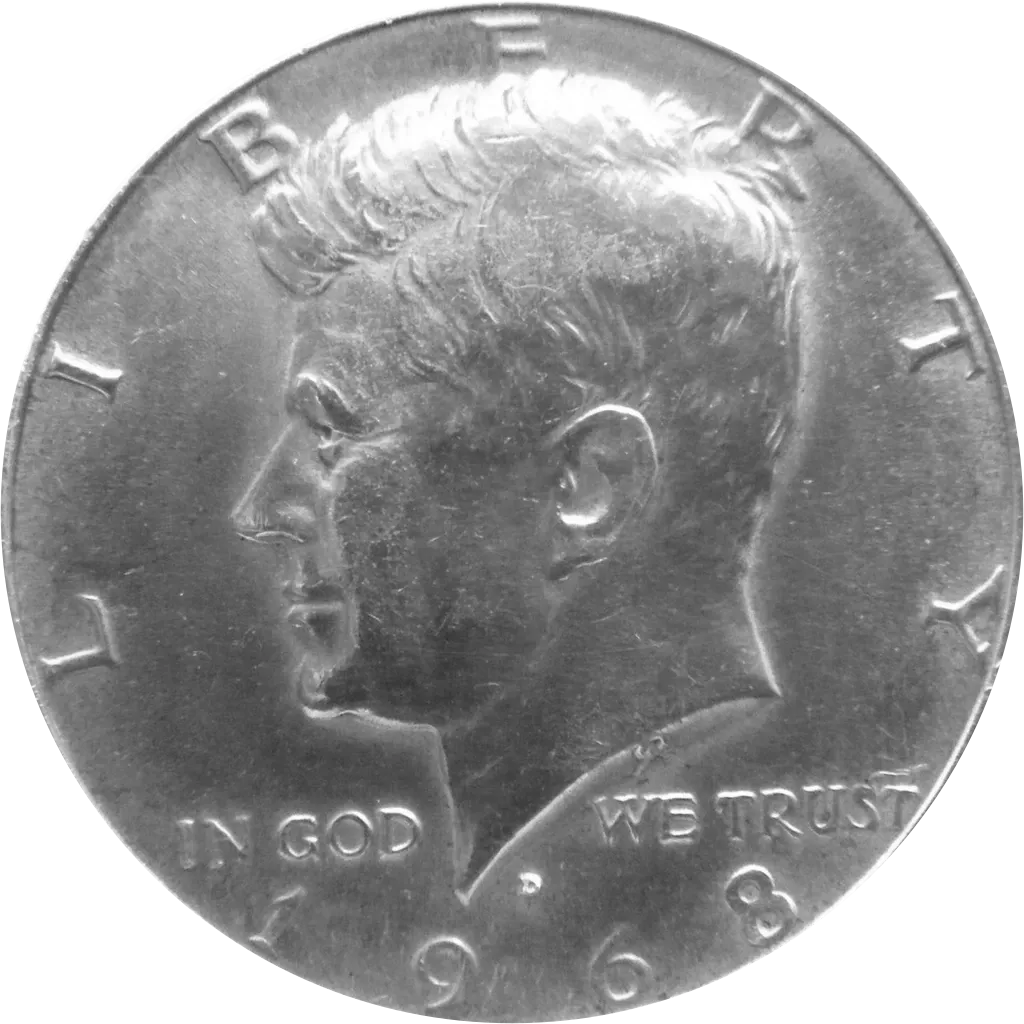
- Kennedy half dollars dated 1965 to 1970 are 40% silver.
- Eisenhower dollars made for collectors at the San Francisco Mint, with an S mintmark, are 40% silver. Every 1971-S and 1972-S is silver. From 1973 on, an S alone doesn’t prove it: a silver one weighs about 24.6 grams and a clad one about 22.7, and the silver ones were sold in blue or brown Mint packaging or in 40% silver sets.
- Jefferson nickels dated 1942 to 1945 with a large P, D or S above the dome of Monticello on the back are 35% silver. A 1942 nickel without that large letter is ordinary copper-nickel.
Dimes and quarters dated 1965 or later, and half dollars dated 1971 or later, hold no silver if they came from circulation. Look at the edge: a copper stripe means the coin is clad.
From face value to ounces of silver
Dealers count 90% silver dimes, quarters and half dollars by face value. Ten dimes, four quarters or two half dollars each make $1 face.
When new, every $1 face of 90% silver coins held about 0.7234 troy ounces of pure silver. Circulated coins have lost a little to wear, so dealers count 0.715 troy ounces for each $1 face. A bag of $1,000 face value is counted as 715 ounces.
Other silver coins are counted one by one. Each Morgan or Peace dollar holds 0.7734 troy ounces, a 40% silver Kennedy half 0.1479, a silver Eisenhower dollar 0.3161 and a war nickel 0.0563.
Here is the arithmetic with a made-up round number for the price of silver, thirty dollars a troy ounce. It is an example only, not today’s price.
Add up the face value
Say your 90% silver dimes, quarters and half dollars come to $20 face value.
Turn it into ounces
Twenty times 0.715 is 14.3 troy ounces of pure silver.
Multiply by the silver price
At thirty dollars an ounce, 14.3 ounces comes to about four hundred twenty-nine dollars. That is the melt value: the silver in the coins at the market price.
Melt value is a market figure for the silver, not an offer. Ask each buyer what they would pay, in dollars, per coin or per $1 face, and compare.
Coins worth more to a collector
Most common, worn silver coins are bought for their silver. Some are worth more to a collector than their silver content:
- Key dates: years and mints that made few coins, such as the 1916-D Mercury dime (264,000 made) and the 1932-D and 1932-S Washington quarters.
- Coins in better condition, with little or no wear.
- Barber coins and anything dated before 1892.
- Proofs, coins in their original Mint packaging, and coins sealed in grading holders.
- Mint errors, such as a dime or quarter dated 1965 struck in silver. Its edge shows no copper stripe.
So bring them as they are, in their albums, holders, tubes and rolls, and don’t clean anything: cleaning can’t be undone. We’ll look at each one.
Selling silver coins to us
You can see today’s prices per coin and per $1 face before you drive, then walk in to our Garden Grove store with no appointment.
Today’s prices for silver coins
| Item | We pay |
|---|---|
| 90% silver dimes, quarters and halves by face value .900 fine · 0.715 oz of fine silver per $1 face | $32.30 per $1 of face value |
| 90% silver dimes (1964 and earlier) .900 fine · 17.9 mm · 0.0715 oz of fine silver each | $3.23 per coin |
| 40% silver Kennedy half dollars (1965–1970) .400 fine · 30.6 mm · 0.1479 oz of fine silver each | $6.68 per coin |
| 35% silver war nickels (1942–1945) .350 fine · 21.2 mm · 0.0563 oz of fine silver each | $2.54 per coin |
| Morgan and Peace silver dollars (1878–1935) .900 fine · 38.1 mm · 0.7734 oz of fine silver each | $34.94 per coin |
We weigh and test every piece in front of you and give you an itemized offer you can take or leave. Bring a valid government photo ID; you must be 18 or older. If you have a large collection, call first so we can set time aside for it, or get a quote from photos.
Questions
How much silver is in $1 face value of 90% silver coins?
About 0.715 troy ounces, for circulated dimes, quarters and half dollars. New coins held about 0.7234 ounces for each $1 face; the smaller figure allows for wear.
Are silver dollars counted the same way?
No. Morgan and Peace dollars are counted by the coin, and each holds 0.7734 troy ounces of silver.
Are 1965 quarters silver?
Dimes and quarters from circulation dated 1965 or later are copper-nickel clad, with no silver. A rare few dated 1965 were struck in silver by mistake; their edges show no copper stripe, so set any like that aside and bring it in.
Should I sort out the valuable coins first?
You can set aside anything in a holder, album or Mint packaging, but don’t clean or polish anything. Bring everything as it is, and we’ll look at each coin.